
*Are Business Cards Still Worth It for a Personal Chef Business?
Many new personal chefs treat business cards like a required first step, when the bigger issue is usually that very few people know the business exists.
A card can support an introduction, but it rarely creates one. In the beginning, the work that creates clients is usually more ordinary like talking to people, following up, staying visible locally, and explaining your service in a way that immediately clicks with the right household.
That tends to produce more business than expensive cardstock.
How Most Personal Chef Clients Hear About You
Meal prep businesses usually grow through repeated exposure over time.
Someone hears your name from a neighbor. A friend mentions your meal prep service. A local fitness instructor follows your Instagram page. Weeks later, the same person sees photos of meals you prepared for another household.
Eventually life becomes busy enough that hiring help starts sounding useful.
That is how many personal chefs end up getting their first few clients.
People hiring a personal chef are inviting someone into their kitchen every week. Familiarity influences those decisions heavily. Referrals and repeated visibility tend to outperform one-time networking interactions.
What Networking Events Often Look Like
The first Chamber mixer I attended involved hundreds of people exchanging business cards almost mechanically.
Everyone walked around carrying stacks. Conversations lasted a few minutes before the next exchange happened. By the end of the night I had a pile of cards from people I barely remembered speaking with.
Most of the cads eventually ended up entered into a database before disappearing into a drawer somewhere.
The experience changed how I thought about networking because very little of it resembled how personal chef clients usually develop.
Weekly meal prep clients tend to come from:
- referrals
- local relationships
- repeated conversations
- online visibility
- existing trust
rather than brief introductions beside a catering table.
Your Online Presence Functions Like the New Business Card
Most people search online immediately after hearing about a business.
They want to:
- browse photos
- read reviews
- understand the services
- see whether the business feels active
- decide whether they trust the person behind the company
That process often happens before someone ever sends an inquiry.
An outdated Instagram page, inactive website, or confusing contact process creates hesitation quickly. A consistent online presence tends to help because potential clients keep encountering the business in different places over time.
Why Some Personal Chefs Stay Invisible
A surprising amount of energy gets spent on branding tasks that do very little to generate conversations.
I’ve seen chefs spend weeks:
- redesigning logos
- choosing fonts
- revising business cards
- adjusting website colors
- rewriting Instagram bios
while almost no time is spent:
- developing referrals
- improving consultations
- talking to potential clients
- building local relationships
- refining how the service is explained
Most early-stage personal chef businesses need visibility far more than visual perfection.
Business Cards Still Have Uses
Business cards tend to work better after a conversation has already happened.
For example, if:
- a neighbor asks about your meal prep service
- someone at a dinner party wants your information
- a gym trainer asks whether you work with busy professionals
- a realtor meets clients relocating into the area
- a current client wants to refer you to a friend
having a simple card available can still be useful.
In those situations, the card supports an existing interaction instead of trying to create one from scratch.
For personal chefs, referrals and familiarity usually carry far more weight than cold networking.
What Builds Trust Faster
Trust in household service businesses usually develops through repeated exposure.
Someone sees:
- your meals online
- another family recommending you
- photos from cook sessions
- consistent activity over time
- referrals from people they already know
If you want to learn how experienced personal chefs structure referrals, consultations, pricing, marketing, and recurring meal prep clients, the Personal Chef Business in 10 Weeks program walks through the operational side of building the business.
Learn how the Personal Chef Business operates behind the scenes here →
FAQ
Do personal chefs still use business cards?
Some do, especially during vendor events and local networking opportunities, though many clients now research businesses online before reaching out.
What marketing works best for personal chefs?
Referrals, repeated visibility, consultations, local relationships, and consistent online activity tend to produce stronger household service leads.
How do personal chefs usually get their first clients?
Many personal chefs begin through conversations, referrals, gyms, neighborhood relationships, wellness communities, and existing social circles.
Resources
Related Reading: Why Marketing Skills Matter More Than Most Personal Chefs Expect

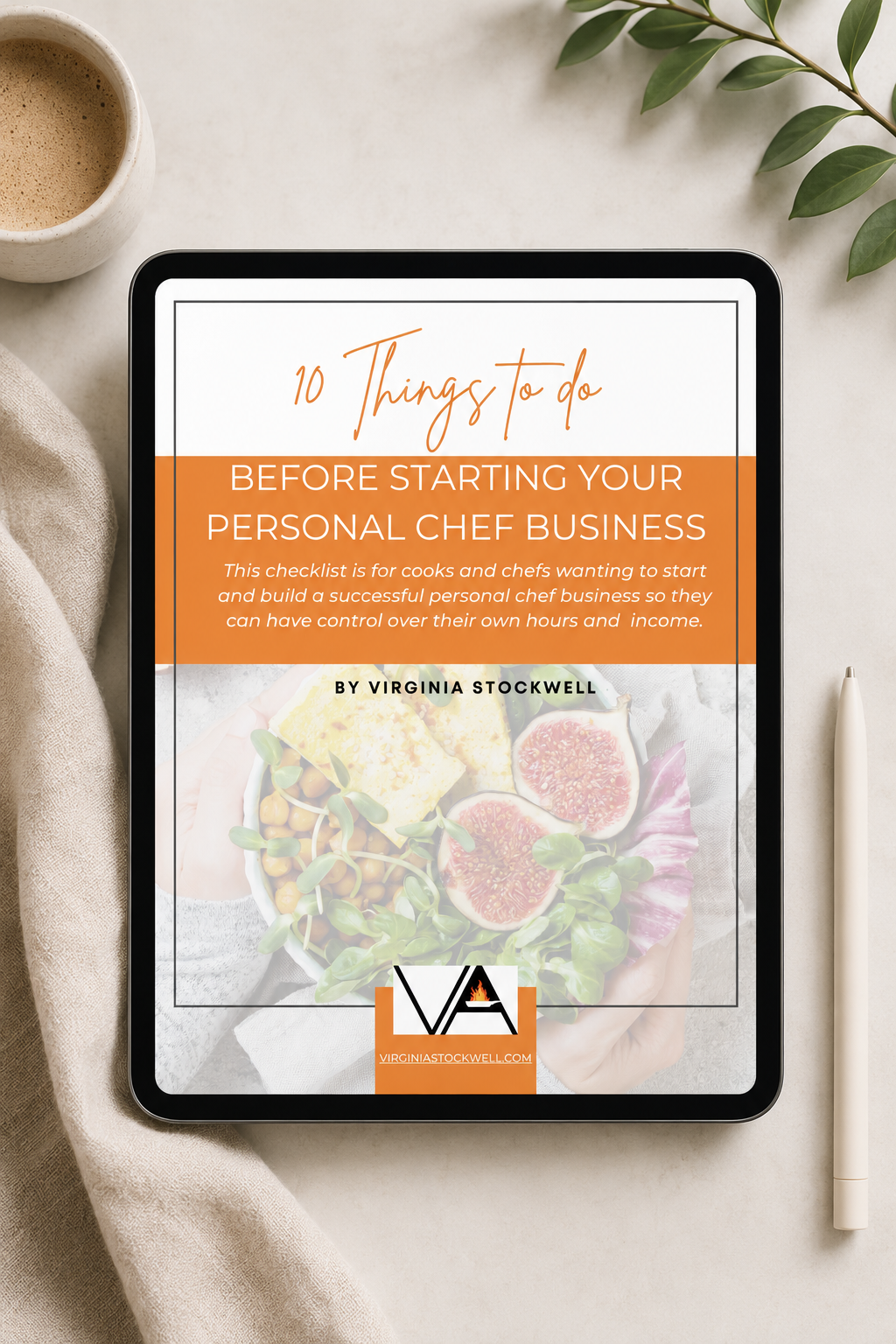
10 Things to Do Before Starting Your Personal Chef Business
Ten-Step Actionable Checklist of things to do before investing in this new business so you're prepared when your first paying client comes along.
for Free
Personal Chef Mentor

Virginia Stockwell
Virginia Stockwell is a personal chef business mentor from California, now living in Austin, TX. She's had careers as a chiropractor and Realtor, then finally found her calling as a personal chef. Starting in catering in 2005, she began her personal chef business in 2012, quickly growing to a waiting list of clients thanks to her local marketing expertise. She now empowers home cooks and professional chefs to start their own meal prep and dinner party businesses, creating a life of hours and income they control. She lives the life of a minimalist both personally and professionally, reads cookbooks like novels, and is locally famous for her taco and margarita parties (check out "A Taco Walks into a Bar" on Amazon).
10-Step Actionable Checklist
FREE DOWNLOAD
10-Step Actionable Checklist
You've always said that "someday" you'll start that meal prep or dinner party business, but where do you begin?