
*Why Can't I Just Cook Out of My House and Deliver Food?

I hear this question all the time.
Someone discovers the personal chef business, sees how little overhead it requires, and then asks:
"Why can't I just cook the food at home and deliver it?"
The answer is that cooking inside a client's kitchen and preparing food in your own kitchen for delivery are treated very differently.
People often lump meal prep delivery and personal chef services together, but regulators do not.
What Happens When You Cook Food for Delivery?
The moment food leaves your house and travels to someone else's, the conversation changes.
The concern is no longer limited to whether the food was cooked properly.
Questions start appearing about where the ingredients came from, how they were stored, how long they sat before delivery, how they were transported, and whether they remained at safe temperatures throughout the process.
The food is being evaluated from the time ingredients enter the operation until the client receives the finished product.
That level of oversight is one reason many home kitchens never become approved food production facilities.
Why Most Home Kitchens Don't Pass
Residential kitchens are designed for families.
Commercial kitchens are designed for food production.
Those two goals create very different requirements.
Depending on your location, a commercial kitchen may require:
- Separate handwashing sinks
- Separate mop sinks
- Commercial ventilation
- Commercial refrigeration
- Three-compartment dishwashing systems
- Dedicated food storage areas
- Washable surfaces
- Separation between living space and food preparation space
Pets may be prohibited from entering food preparation areas.
Open-concept kitchens may require modifications.
Additional refrigeration may be necessary for cooling and storage.
Many people begin researching requirements and quickly realize they are no longer talking about a few upgrades.
They are looking at a major construction project.
The Kitchen Is Only One Part of the Cost
Even if the kitchen passes inspection, the operation itself still has to comply with food safety requirements.
Food storage, cool, and transportation procedures must be followed. Inventory storage must be handled properly. Packaging and delivery procedures may also be reviewed.
A food business producing meals for delivery is responsible for much more than cooking.
What About Cottage Food Laws?
This is where many people become confused.
They hear about Cottage Food Laws and assume they can use them to operate a meal prep business from home.
In many areas, Cottage Food Laws were created for low-risk foods that remain stable without refrigeration.
Examples often include:
- Cookies
- Breads
- Cakes
- Candies
- Dry mixes
- Certain jams and preserves
The exact rules vary by location.
The important limitation is that most meal prep businesses are preparing foods that require temperature control.
Examples include:
- Meat
- Poultry
- Seafood
- Refrigerated foods
- Prepared meals
- Foods intended for reheating later
Those foods are frequently regulated under a different set of rules than shelf-stable baked goods.
Before investing time and money into a home-based meal prep business, review the requirements specific to your city, county, and state.
Why Personal Chefs Often Cook in Client Homes
This is one reason the personal chef business appeals to so many people.
The client purchases the groceries, then meals are prepared in the client's kitchen. You as the chef are performing a service only.
That arrangement eliminates many of the storage, transportation, and facility requirements associated with producing meals in one location and delivering them somewhere else.
It also dramatically reduces startup costs, not to mention the generous water and electricity costs of cooking from your personal home.
Why the Startup Costs Are Different
A personal chef business can often begin with:
- A business license
- Liability insurance
- A website
- Transportation
A meal delivery operation may require:
- Commercial kitchen space
- Specialized refrigeration
- Food storage systems
- Transportation equipment
- Inspections
- Ongoing compliance procedures
The difference in startup costs and logistics are substantial.
Which Option Makes More Sense?
Many people begin by looking for the simplest way to sell food.
After researching regulations, kitchen requirements, transportation procedures, and startup costs, they often discover that cooking inside client homes provides a much more practical path into the industry.
For weekly meal prep services, it is the simpler business model.
The Personal Chef Business in 10 Weeks
Questions about licensing, pricing, client acquisition, consultations, scheduling systems, and meal prep workflow are covered throughout the Personal Chef Business in 10 Weeks program.
If you're exploring different ways to enter the industry, the program walks through how the personal chef business operates from the first client through recurring meal prep service.
Learn how the Personal Chef Business operates behind the scenes here >>
FAQ
Can I cook meals at home and sell them?
The answer depends on your location, the foods being prepared, and the regulations that apply in your area. Not just your state, but also your city or county.
Can Cottage Food Laws be used for meal prep businesses?
Many Cottage Food Laws focus on low-risk shelf-stable foods and may not apply to prepared meals requiring refrigeration or temperature control.
Why do personal chefs cook in client homes?
Preparing food in the client's kitchen avoids many of the facility, storage, and transportation requirements associated with commercial food production.
How much does it cost to build a commercial kitchen?
Costs vary significantly depending on location, equipment, construction requirements, and local regulations but you can guess $100,000+.
Resources

10 Things to Do Before Starting Your Personal Chef Business
Ten-Step Actionable Checklist of things to do before investing in this new business so you're prepared when your first paying client comes along.
for Free
Personal Chef Mentor

Virginia Stockwell
Virginia Stockwell is a personal chef business mentor from California, now living in Austin, TX. She's had careers as a chiropractor and Realtor, then finally found her calling as a personal chef. Starting in catering in 2005, she began her personal chef business in 2012, quickly growing to a waiting list of clients thanks to her local marketing expertise. She now empowers home cooks and professional chefs to start their own meal prep and dinner party businesses, creating a life of hours and income they control. She lives the life of a minimalist both personally and professionally, reads cookbooks like novels, and is locally famous for her taco and margarita parties (check out "A Taco Walks into a Bar" on Amazon).
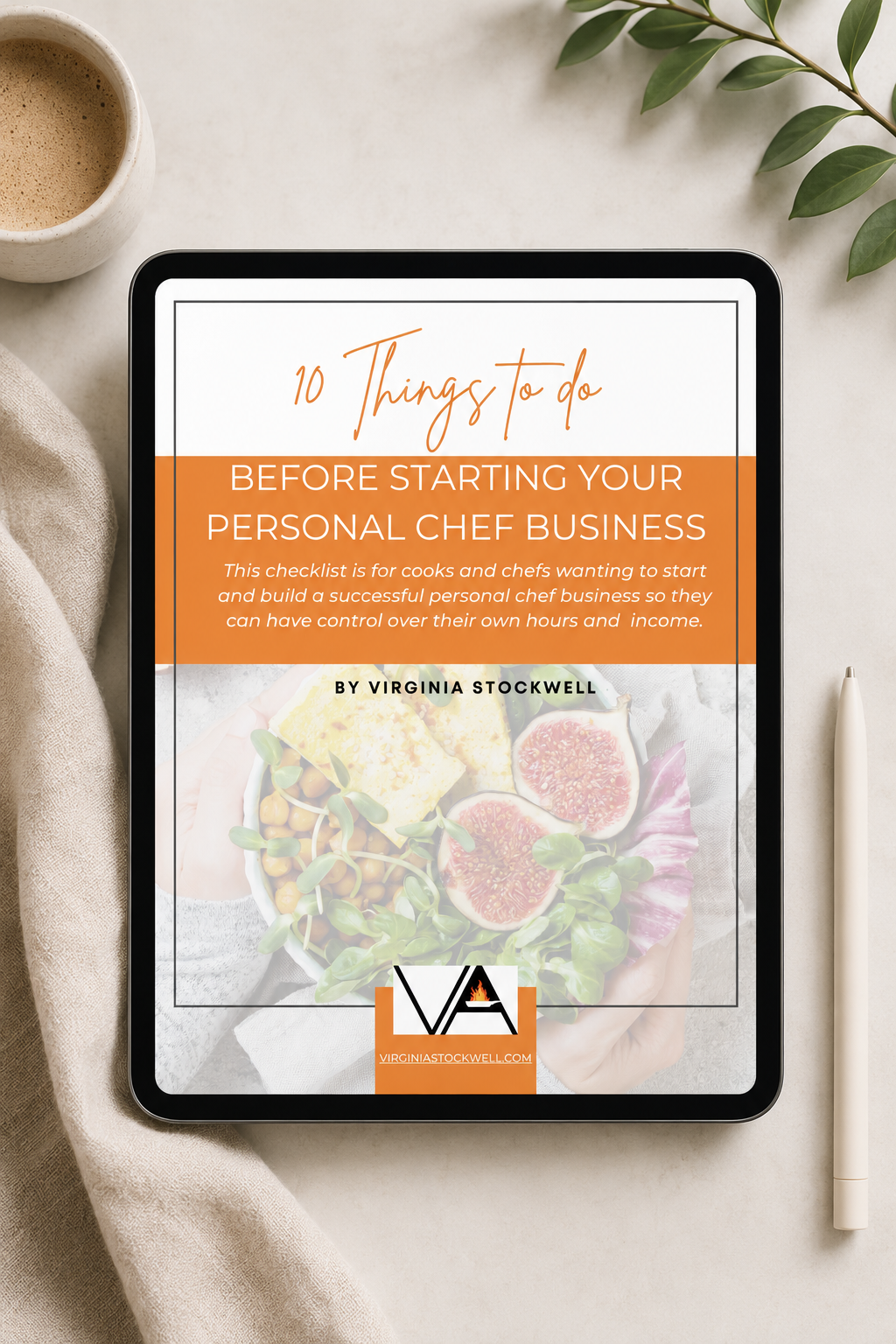
10-Step Actionable Checklist
FREE DOWNLOAD
10-Step Actionable Checklist
You've always said that "someday" you'll start that meal prep or dinner party business, but where do you begin?