
*Should You Offer Discounts in Your Personal Chef Business?
One of the first pricing challenges many personal chefs encounter has nothing to do with clients.
It comes from friends and family.
Someone hears you started a personal chef business and asks whether you would be willing to cater an event for free or offer a discount to "help get your name out there."
People assume a new business needs exposure more than revenue.
👉Before the requests happen, decide how you want to handle them.
The First Discount Request Usually Feels Different
When I first started my business, a friend who owned a hair salon invited me to cater an art opening.
I was excited.
I spent time researching appetizers, putting together menu ideas, and building a proposal. Since it felt like my first opportunity to cater an event, I wanted everything to be done well.
Then the response came back.
She assumed I would provide the food for free because I was new in business and would benefit from the exposure.
What I thought was a catering opportunity became a request to donate food, ingredients, preparation time, transportation, and labor.
The event was free only for her.
Someone still had to pay for the food and spend hours preparing it.
Exposure Does Not Always Produce Clients
One of the assumptions behind free work is that exposure eventually turns into revenue.
Sometimes it does.
Many times it doesn't.
People attending an art opening are usually focused on:
- the artwork
- the venue
- the social event
- the free food
Very few spend the evening actively looking for a personal chef.
That does not mean community involvement never creates opportunities.
It means there should be a reason for participating beyond vague promises of exposure.
Before agreeing to a discounted event, ask:
- Is this the type of audience that hires personal chefs?
- Are these people likely to need meal prep services?
Those questions often provide better answers than "it will be good exposure."
Discounts Create Expectations
One of the challenges with discounts is that they can change how people view the service.
If someone hires you because you were the cheapest option, they often continue looking for the cheapest option.
Clients focused primarily on price tend to compare:
- discounts
- promotions
- coupons
- special offers
rather than the value of the service itself.
The Better Question Is Why Discounts Keep Coming Up
If one person asks for a discount, that is normal.
If almost everyone asks for a discount, it may be worth examining something deeper.
Questions worth asking include:
- Am I attracting the right type of client?
- Am I explaining the value of my services?
- Does my marketing attract bargain hunters?
- Is my target market aligned with my pricing?
Pricing problems are not always pricing problems.
Sometimes they are positioning problems.
Community Involvement Is Different Than Discounting
There is a difference between donating your services to a cause you believe in versus feeling pressured to discount your work because someone assumes you should.
One is a deliberate business decision.
The other is a pricing discussion disguised as an opportunity.
Those situations deserve different responses.
What Experienced Personal Chefs Know About Pricing
The clients who value your service focus on:
- convenience
- consistency
- reliability
- saving time
- reducing stress
The conversation becomes less about discounts and more about whether the service solves their problem.
Learn how to price your services here >>
FAQ
Should personal chefs offer discounts?
Some personal chefs choose to offer discounts strategically, but many prefer to establish pricing that reflects the value of the service from the beginning.
Does free work generate personal chef clients?
Sometimes. The quality of the audience often determines whether free work leads to future business.
Why do people ask personal chefs for discounts?
Friends, family, and potential clients may assume exposure benefits a new business. Those requests often appear during the early stages of building a client base.
If everyone asks for a discount, what does that mean?
It may indicate a mismatch between your pricing, positioning, marketing, or target market.
Resources

10 Things to Do Before Starting Your Personal Chef Business
Ten-Step Actionable Checklist of things to do before investing in this new business so you're prepared when your first paying client comes along.
for Free
Personal Chef Mentor

Virginia Stockwell
Virginia Stockwell is a personal chef business mentor from California, now living in Austin, TX. She's had careers as a chiropractor and Realtor, then finally found her calling as a personal chef. Starting in catering in 2005, she began her personal chef business in 2012, quickly growing to a waiting list of clients thanks to her local marketing expertise. She now empowers home cooks and professional chefs to start their own meal prep and dinner party businesses, creating a life of hours and income they control. She lives the life of a minimalist both personally and professionally, reads cookbooks like novels, and is locally famous for her taco and margarita parties (check out "A Taco Walks into a Bar" on Amazon).
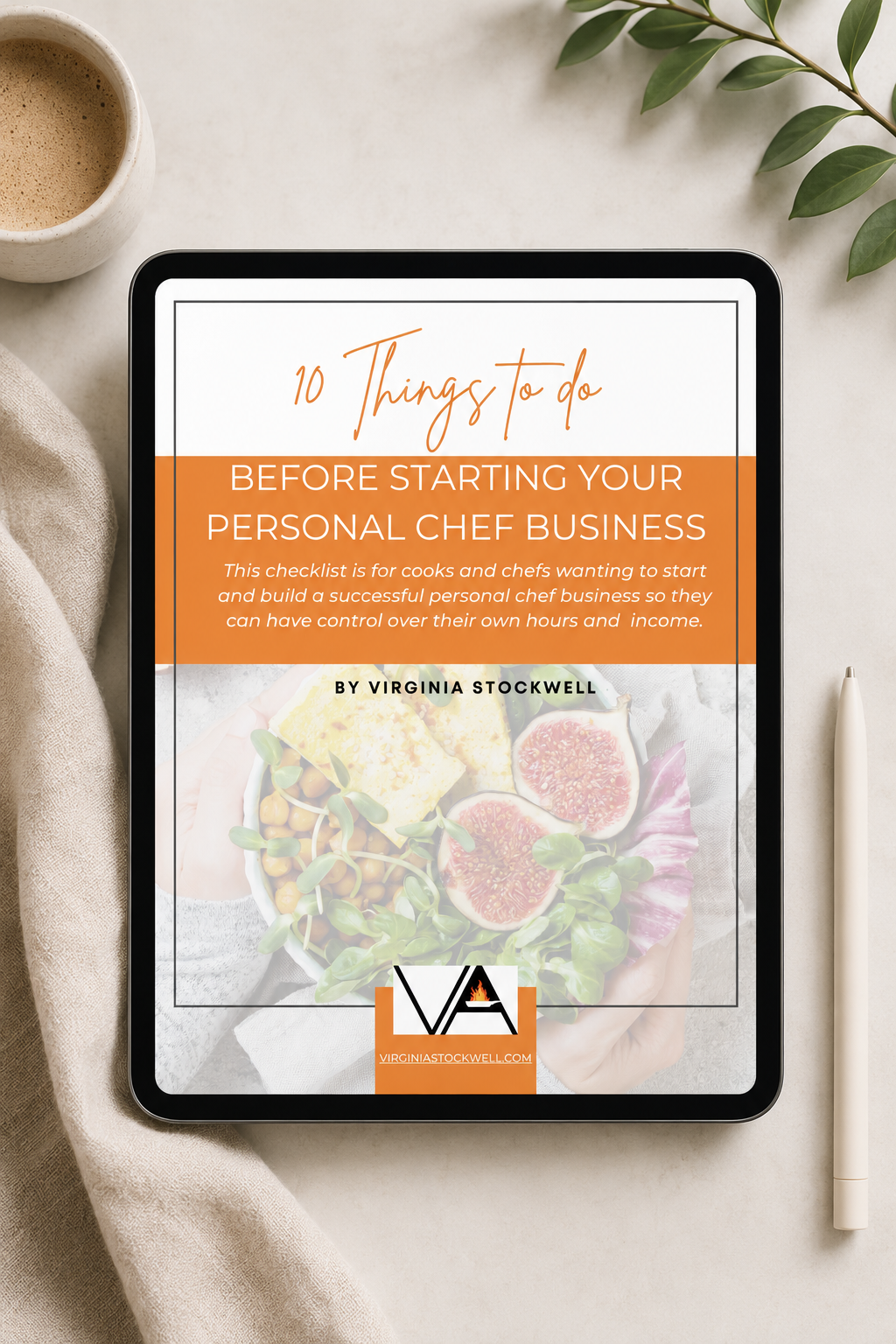
10-Step Actionable Checklist
FREE DOWNLOAD
10-Step Actionable Checklist
You've always said that "someday" you'll start that meal prep or dinner party business, but where do you begin?