
*Is Overwhelm Keeping You From Starting Your Personal Chef Business?

Most aspiring personal chefs do not struggle because they lack cooking skills.
They struggle because they are trying to answer every business question before taking the first step.
Questions start piling up quickly.
- How much should I charge?
- How do I get a business license?
- Where do I find clients?
- What should I name my business?
- How do I market myself?
- How much can I make?
At first, it feels responsible to research everything.
After a while, the research becomes a substitute for action.
Why Overwhelm Happens
Starting a personal chef business requires learning several new skills at the same time.
Cooking is only one piece of it.
You are also learning:
- Pricing
- Marketing
- Consultations
- Scheduling
- Client communication
- Business operations
Looking at all of those topics at once can make the business feel much larger than it really is.
Many people become overwhelmed because they are trying to solve problems they will not encounter for months.
The Internet Creates a New Problem
When I started my personal chef business, I spent months searching for answers.
Today, information is easier to find.
The challenge now is sorting through it.
You can spend hours reading articles, watching videos, listening to podcasts, and asking AI tools questions about every possible business scenario.
That does not necessarily move the business forward.
At some point, the next useful lesson comes from talking to potential clients, conducting consultations, and testing ideas in your own community.
Most Questions Become Easier After the First Client
Many aspiring chefs assume they need every answer before finding a client.
The opposite is often true.
The first client teaches things that are difficult to learn any other way.
You begin seeing:
- Which services people request
- What questions clients ask
- Which menus work well
- How long tasks take
- What people are willing to pay
That information becomes far more valuable than another week spent researching hypothetical situations.
How Much Can a Personal Chef Make?
Income varies depending on your location, pricing, schedule, and services.
Many personal chefs begin with startup costs around $500 because the business can be operated inside client homes without leasing commercial kitchen space.
A single meal prep session often generates a few hundred dollars depending on the area, the service provided, and the chef's experience.
Private events can generate significantly more revenue, especially as experience, referrals, and demand increase.
The business grows one client at a time.
What Should You Focus On First?
Most new personal chefs benefit from focusing on the next step rather than the next fifty steps.
If you do not have clients yet, focus on understanding who hires personal chefs in your area.
If consultations are not converting, focus on improving consultations.
If your schedule is full, focus on systems and efficiency.
The business becomes much easier to manage when attention stays on the problem directly in front of you.
The Personal Chef Business
Many aspiring chefs spend years piecing together information from articles, videos, social media posts, and online discussions.
Questions about pricing, client acquisition, consultations, scheduling systems, referrals, and meal prep workflow are covered throughout the Personal Chef Business in 10 Weeks program and inside the Template Shop.
If you're tired of jumping between dozens of different sources looking for answers, I organize the business side of the profession into one place.
FAQ
Why do aspiring personal chefs feel overwhelmed?
Most are trying to learn pricing, marketing, consultations, licensing, scheduling, and client acquisition at the same time.
Do I need every answer before starting a personal chef business?
No. Many important lessons come from working with the first few clients rather than from research alone.
What should I focus on first?
Focus on the next business challenge directly in front of you instead of trying to solve every future problem at once.
How much does it cost to start a personal chef business?
Many personal chefs begin with relatively low startup costs because they cook in client homes rather than operating commercial kitchen facilities.
Resources

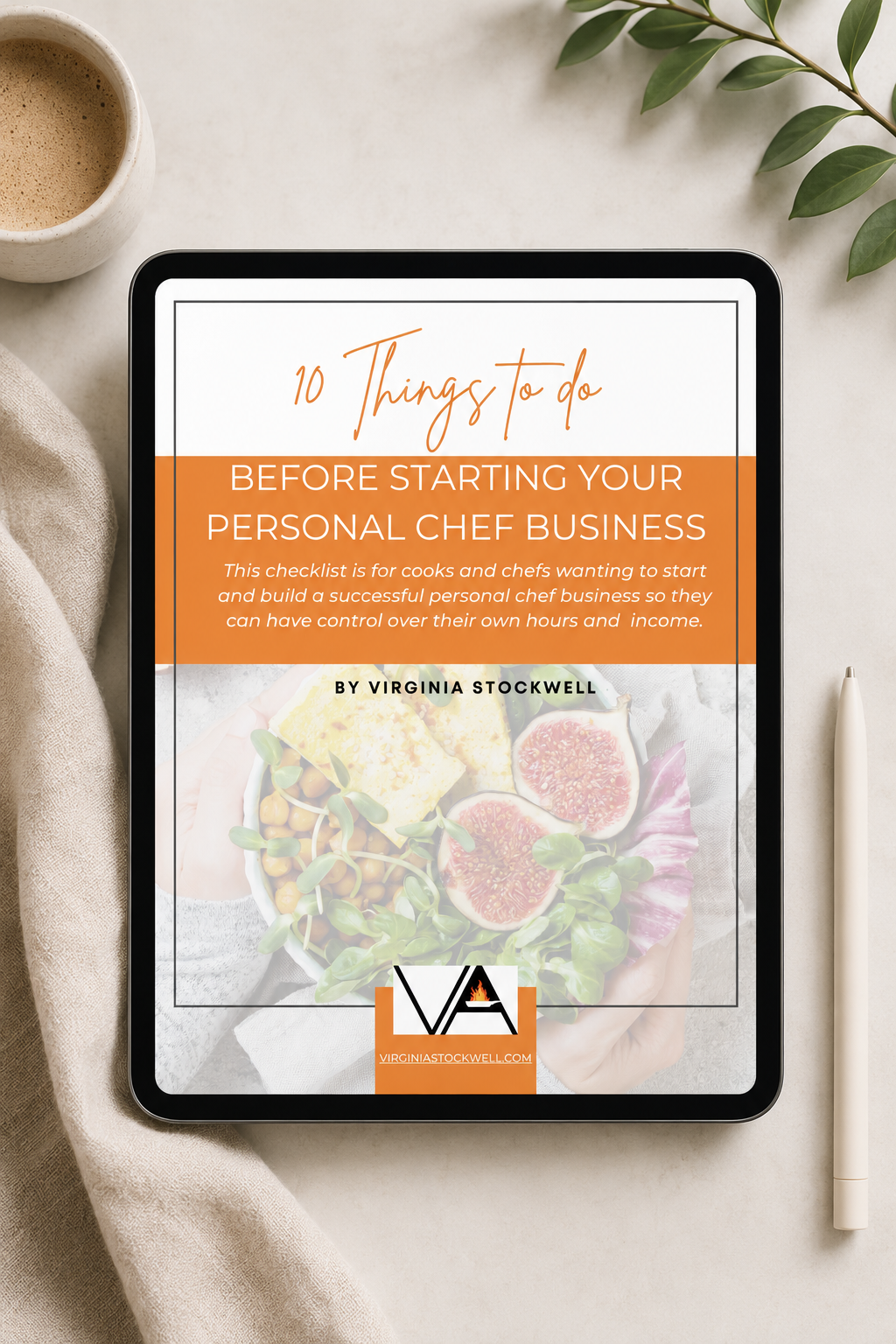
10 Things to Do Before Starting Your Personal Chef Business
Ten-Step Actionable Checklist of things to do before investing in this new business so you're prepared when your first paying client comes along.
for Free
Personal Chef Mentor

Virginia Stockwell
Virginia Stockwell is a personal chef business mentor from California, now living in Austin, TX. She's had careers as a chiropractor and Realtor, then finally found her calling as a personal chef. Starting in catering in 2005, she began her personal chef business in 2012, quickly growing to a waiting list of clients thanks to her local marketing expertise. She now empowers home cooks and professional chefs to start their own meal prep and dinner party businesses, creating a life of hours and income they control. She lives the life of a minimalist both personally and professionally, reads cookbooks like novels, and is locally famous for her taco and margarita parties (check out "A Taco Walks into a Bar" on Amazon).
10-Step Actionable Checklist
FREE DOWNLOAD
10-Step Actionable Checklist
You've always said that "someday" you'll start that meal prep or dinner party business, but where do you begin?