
How do I move my personal chef business into a commercial space?

When your schedule is maxed out with clients and catered dinners, you may consider moving into a commercial kitchen one or two days a week.
There are often plenty of restaurants or community centers (church or fire department kitchens) that are willing to sublet their kitchen to you. They appreciate the additional income and you will appreciate not locking yourself into a lengthy contract.
It is not suggested to START your personal chef business with a commercial kitchen as without a client base to pay for that kitchen, you're doing the hope and pray method of starting a small business.
Working in client homes, there is no overhead, so if you don't have clients in the beginning, you're not simultaneously losing money with commercial kitchen payments.
It's likely there are going to be only a few choices in your community for your new commercial kitchen space, so you may not have the luxury of being picky. If you do have a variety to choose from, however, you're better...
*Should Personal Chefs Turn Down Clients With Severe Food Allergies?

One of the first meal prep consultations that made me nervous involved a young boy with severe food allergies.
The family handed me a list of restricted foods that seemed to go on forever. I remember looking at it and thinking I was probably the wrong chef for the job. At that point in my career, the responsibility felt overwhelming, and I worried about making a mistake.
The parents had a completely different reaction.
They weren't focused on whether I had experience with allergy-friendly menus. They were exhausted and needed help.
Can Personal Chefs Work With Clients Who Have Severe Food Allergies?
Yes.
Many personal chefs work successfully with allergy clients. The decision depends on the severity of the allergy, the family's requirements, and your comfort level managing those restrictions safely.
The consultation is where those conversations need to happen.
Why This Family Needed a Personal Chef
As we talked more, I began understanding why they were looking for help.
Every...
*Freezing Meals as a Personal Chef

One of the most common questions aspiring personal chefs ask is whether clients want freezer meals.
The answer is sometimes, but probably less often than you think.
Most recurring meal prep clients hire a personal chef because they want fresh meals available throughout the week. Households receiving weekly service rarely ask for an entire month of dinners to be frozen at one time.
Where freezing becomes useful is as an additional service.
Freezer Meals Can Be a Valuable Upsell
Many personal chefs focus entirely on the meals being prepared for the current week.
Meanwhile, clients often appreciate having a few extra items available for busy days, unexpected schedule changes, or future meals.
Some examples include:
- Meatballs
- Smoothie packs
- Individual lasagnas
- Burgers
- Soups
- Breakfast sandwiches
- Cookie dough portions
These freezer items can often be prepared alongside the regular cook session and offered as an additional service.
For many households, having a few backup ...
*Should Personal Chefs Accept Every Client?
I once sat down for a meal prep consultation that sounded promising at first.
Both parents worked long hours and wanted help getting dinner on the table during the week. Situations like that are often a good fit for meal prep services, so I expected a fairly straightforward conversation.
As we talked through what everyone liked to eat, the situation became more complicated. The wife followed a vegan diet, the husband preferred meat with most meals but also avoided gluten, one child had a nut allergy, and the other children were perfectly happy rotating between chicken fingers and macaroni and cheese.
About halfway through the discussion, I realized I wasn't creating a menu for a family. I was trying to create several different menus that happened to share the same address.
Can a Personal Chef Work With Every Household?
No.
Some households are much easier to serve than others. Multiple dietary restrictions, food allergies, and conflicting meal preferences can create a level of com...
*Personal Chef Business Plan: What You Actually Need (and What to Skip)

You do not need a detailed business plan to start a personal chef business.
Many new chefs spend weeks researching templates, writing mission statements, and planning finances. None of that gets you your first client.
What you actually need is a simple plan you can act on immediately.
This guide shows what to include in a personal chef business plan and what you can skip.
Do You Need a Business Plan for a Personal Chef Business?
You do not need a formal business plan to start.
You do not need financial projections.
You do not need a mission statement.
You do not need funding.
A detailed business plan is only necessary if you are applying for a loan or outside investment.
As a personal chef, your first priority is getting your first client, not writing a document.
What to Include in a Simple Personal Chef Business Plan
A simple one-page plan is enough to get started.
Include:
- The services you plan to offer
- Your business name and what makes your service different
- Your ide ...
*Should You Offer Discounts in Your Personal Chef Business?
One of the first pricing challenges many personal chefs encounter has nothing to do with clients.
It comes from friends and family.
Someone hears you started a personal chef business and asks whether you would be willing to cater an event for free or offer a discount to "help get your name out there."
People assume a new business needs exposure more than revenue.
👉Before the requests happen, decide how you want to handle them.
The First Discount Request Usually Feels Different
When I first started my business, a friend who owned a hair salon invited me to cater an art opening.
I was excited.
I spent time researching appetizers, putting together menu ideas, and building a proposal. Since it felt like my first opportunity to cater an event, I wanted everything to be done well.
Then the response came back.
She assumed I would provide the food for free because I was new in business and would benefit from the exposure.
What I thought was a catering opportunity became a request...
*Personal Chef vs Private Chef: What’s the Difference?
The main difference between a personal chef and a private chef is how they work with clients. A personal chef works with multiple clients and sets their own schedule, while a private chef typically works full-time for one household.
Understanding the difference between a personal chef, private chef, and catering chef helps you decide which career path fits your goals.
What Is a Personal Chef?
As a personal chef, you work for multiple clients.
You control your schedule. You decide how much to charge. You run your business the way you want.
You can also adjust your pricing as your experience grows or as demand increases.
Pros of Being a Personal Chef
- Flexible schedule
- Control over pricing
- Ability to build your own business
- Opportunity to work with multiple clients
Cons of Being a Personal Chef
- No employer benefits
- No 401K
- No health insurance provided
You are responsible for setting up your own health insurance and long-term financial plan.
What Is a Private Che...
*What Stage of the Personal Chef Business Are You In?

Most personal chef businesses move through three stages.
The challenge is that the stages rarely happen in a straight line.
You may be earning money while still figuring out your target market. You may have recurring clients but still be adjusting your pricing. You may be receiving referrals while continuing to refine your service offerings.
Many personal chefs find themselves operating in two stages at the same time.
Understanding your current stage helps determine where your attention belongs.
A lot of business frustration comes from working on problems that belong to a future stage while ignoring the challenges directly in front of you.
The Three Stages of a Personal Chef Business
Most personal chef businesses move through:
- Startup
- Monetization
- Scale
Some chefs move through all three.
Others intentionally remain in one stage because it supports the schedule, income, and lifestyle they want.
Stage 1: Startup
The startup stage begins before the first recurring client...
*Do You Need Culinary School to Be a Chef? (What Actually Matters)

You do not need culinary school to be a chef. A chef is someone who cooks professionally, and there is no requirement that you attend culinary school to use that title.
If you are having confidence issues calling yourself a chef because you did not go to culinary school, you are not alone.
What Is a Chef?
Consider how the term “chef” is defined:
Oxford Dictionary: a professional cook
Merriam-Webster Dictionary: a skilled cook who manages the kitchen
There is no mention of culinary school in either definition.
A chef is defined by what they do, not where they went to school.
Famous Chefs Who Did Not Attend Culinary School
Many well-known chefs did not attend culinary school.
- Gordon Ramsay
- Ina Garten
- Guy Fieri
- Martha Stewart
- Ree Drummond
- Rachael Ray
- Tom Colicchio
- Lidia Bastianich
- Mario Batali
These are all individuals who built successful careers through experience, not formal education.
Why This Comes Up So Often
There is a lot of emphasis placed on culinary scho...
*How Long Can You Work Under the Table as a Personal Chef?

You should not work under the table as a personal chef. Personal chefs handle food, work inside client homes, and operate a business with real liability risks. Operating without a business license or insurance can create legal and financial problems that are far more expensive than setting up your business properly from the beginning.
One of the most common questions aspiring personal chefs ask is:
“How long can I work under the table before making my business legal?”
The short answer is: you should not.
Why Working Under the Table Is Risky
Cooking professionally involves liability.
Consider situations like:
- A client has a severe food allergy
- You accidentally damage the client’s home
- You injure yourself during a cook session
- A client claims food-related illness
These situations are uncommon, but they are the reason professional businesses protect themselves legally and financially.
Personal Chefs Need Liability Insurance
Liability insurance is one of the most important...

10 Things to Do Before Starting Your Personal Chef Business
Ten-Step Actionable Checklist of things to do before investing in this new business so you're prepared when your first paying client comes along.
for Free
Personal Chef Mentor

Virginia Stockwell
Virginia Stockwell is a personal chef business mentor from California, now living in Austin, TX. She's had careers as a chiropractor and Realtor, then finally found her calling as a personal chef. Starting in catering in 2005, she began her personal chef business in 2012, quickly growing to a waiting list of clients thanks to her local marketing expertise. She now empowers home cooks and professional chefs to start their own meal prep and dinner party businesses, creating a life of hours and income they control. She lives the life of a minimalist both personally and professionally, reads cookbooks like novels, and is locally famous for her taco and margarita parties (check out "A Taco Walks into a Bar" on Amazon).
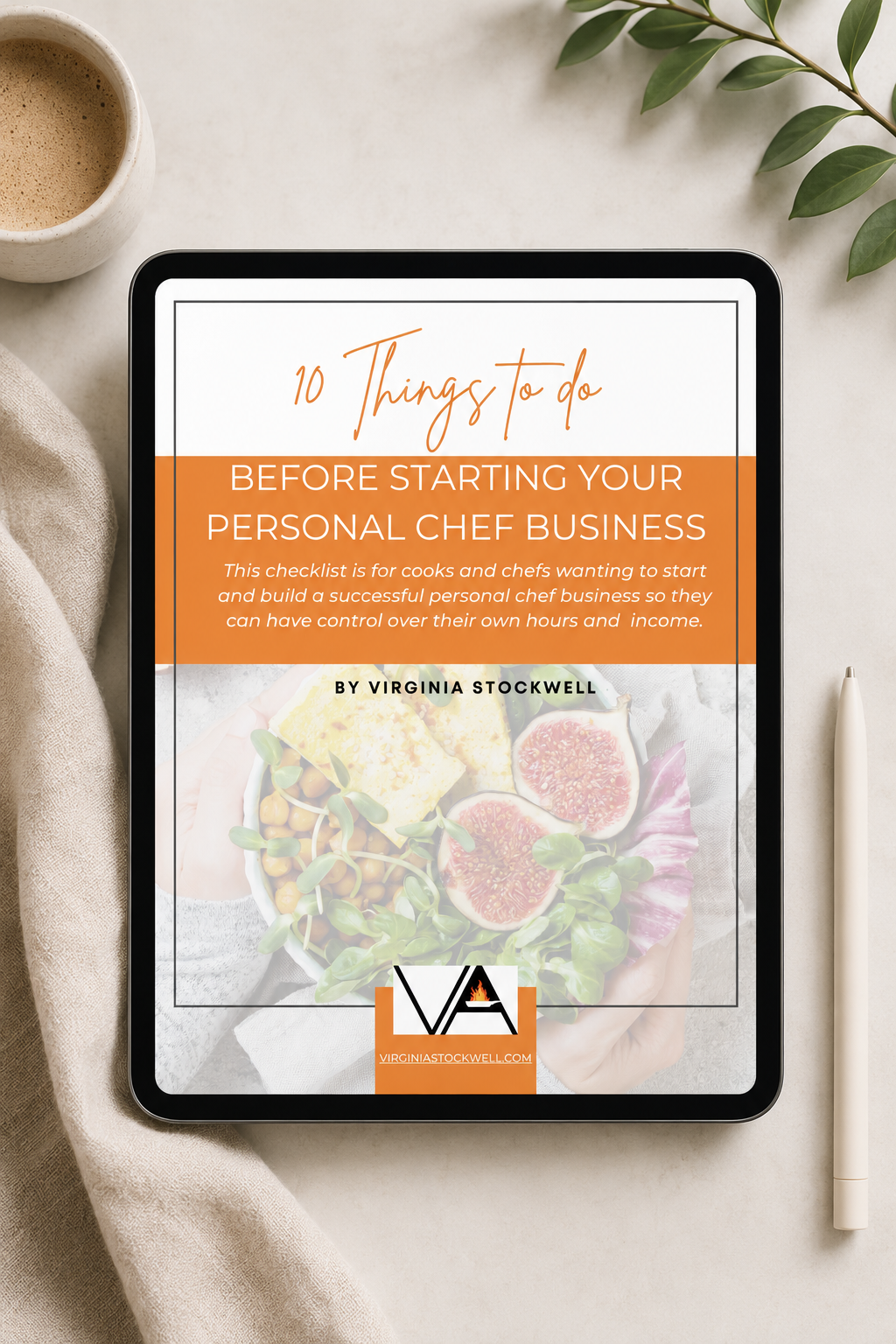
10-Step Actionable Checklist
FREE DOWNLOAD
10-Step Actionable Checklist
You've always said that "someday" you'll start that meal prep or dinner party business, but where do you begin?