
*Self-Doubt Keeps Many Personal Chefs From Starting
Fear and self-doubt stop many aspiring personal chefs long before pricing, marketing, or cooking ability become the issue.
The hesitation usually starts earlier.
Someone considers offering meal prep services, then immediately begins questioning whether anyone would hire them, whether their food is good enough, or whether they know enough to charge professionally. Weeks pass researching the business while avoiding the parts that would answer those questions fastest: talking to potential clients, scheduling consultations, testing demand, and cooking for paying households.
How Self-Doubt Shows Up in the Personal Chef Business
Most people do not describe it as fear.
It usually appears as:
- overpreparing
- delaying decisions
- endlessly adjusting pricing ideas
- rebuilding websites before getting clients
- researching equipment instead of marketing services
The thinking sounds practical on the surface.
Meanwhile, the business never moves forward.
Why New Personal Chefs Question Thei...
Become a celebrity in the Personal Chef space

As a personal brand, you already know that the biggest factor causing clients to hire you for services is connection.
In other words, if people don't feel a connection with you, they're not likely going to invest in you and your services.
The reality is that online video is the most effective medium for creating that connection. It's why we feel so connected with celebrities and follow them on social media.
90% of communication is non-verbal, so people are connecting with all of you, not just your voice, tone and pitch but your whole presence. Your energy.
If you're refusing to do video like many struggling personal chefs, you're basically trying to start a business while hiding from people. Without video, you won't have that real connection.
The people you follow and look up to online to have truly shown who they are. They have connected with you on an intimate level through the power of video.
It's time to overcome your fear of rejection and get on video....
Your Personal Chef Business is a Gift

Do you find yourself constantly researching, gathering information on the personal chef business?
Is gathering information becoming a hobby instead of what you know you should be doing...implementing the information?

There is a turning point in starting absolutely any business when it's time to shift from information to implementation, but how do you know when it's time?
Implementation over Information
There are a myriad of different kinds of personalities when jumping into a new business venture.
- The analyst will need to gather absolutely all the facts possible, spending hours and hours online.
- The perfectionist will need to ensure every item on their checklist is complete, possibly too much time.
- The risk taker will dive right in and may not do any research at all, so may appear sloppy.
- The collaborator will need to have a buddy ready to take the business risk with them because they're uncomfortable taking the risk on their own.
- The know-it-all won't ...
*Employee Mindset vs. Personal Chef Business Owner Mindset

Why Many Personal Chefs Undercharge in the Beginning
Many personal chefs undercharge because they approach pricing the same way restaurant employees think about hourly labor.
A cook earning $20 an hour in a restaurant may assume charging $30 an hour independently sounds profitable. The structure feels familiar because restaurant work trains people to connect income directly to time worked.
Personal chef businesses function differently.
Recurring clients are usually paying for household support, meal consistency, grocery coordination, dietary management, scheduling relief, kitchen organization, and weekly convenience. Cooking remains important, but clients rarely evaluate the service by calculating how long vegetable prep required or how many minutes cleanup took afterward.
Once recurring clients enter the picture, efficiency starts changing the business quickly.
A personal chef who already knows the kitchen layout, remembers family preferences, and understands the household routi...
What does niching mean in the Personal Chef Business?

Do you often hear this statement?
"You need to niche to bring customers to your business."
What does that really mean?
The dictionary calls a niche, "distinct segment of the market" and yes, that summarizes it, but just somewhat.
As a personal chef, you can't cook all things for all people. Which business do you think receives more new client requests?
- JoAnne's Personal Chef Services specializes in making your Atlanta bachelorette party an evening with friends that will always be remembered as one of the best events of your life.
- JoAnne's Personal Chef Services offers meal prep, dinner parties and cooking classes for those in Atlanta, Georgia.
Another way to look at it is by asking yourself what you would do if you were having marriage problems. Which company would you call?
- Sam's Counseling Service: serving the Kirkland, Washington neighborhoods
- Sam's Marriage Counseling Service: helping Kirkland residents work through relationship issues of grief, resentmen ...
*How to Get Clients for Your Personal Chef Business

Getting clients for a personal chef business starts with targeting the right people, not trying to reach everyone.
Most new personal chefs ask, “How do I get clients?”
That question leads to scattered marketing and inconsistent results.
A better question is:
Who is the right client for my service?
This guide shows how to get personal chef clients by focusing on the right audience first, then putting your service in front of them.
Why Most Personal Chefs Struggle to Get Clients
The problem is not a lack of marketing.
The problem is trying to attract anyone who needs food.
When your message is too broad, it does not connect with people who are ready to hire you.
This leads to:
- Discounting your services
- Inconsistent bookings
- Slow business growth
You are not looking for more people.
You are looking for the right people.
Step 1: Define Your Ideal Personal Chef Client
Before marketing your services, define who you want to work with.
Ask:
- Who can afford my services?
- W ...
Restaurant, Catering, Cooking From Home

There are so many different ways to craft a career out of your culinary skills.
- open a restaurant
- start a catering company
- begin a personal chef service
- work for one family as a private chef
- cook and deliver from your home
Which one will work for you? It's even possible you may dabble in more than one in your lifetime. 🤔
Personal Chef vs. Private Chef
The personal versus private chef is the most confusing to people. In summary, a private chef works for just one client while a personal chef has many clients.
As a private chef, you are an employee of your client and may receive benefits such as paid vacation time or health insurance. Sure, it's great that you have "for sure" income each month, but the drawback is that you are still an employee and lack the freedom of being your own boss.
The contract between you and your employer will lay out the terms of the job to include days of the week you will work and how long you are guaranteed a job. Even though a contrac...
10 Step Action Checklist for Business Launch

Is this you:
- You pour your all into cooking for your friends and they're always complimenting you on your culinary skills
- People are always saying "you should open a restaurant!" but the thought of working every weekend of your life and 15-hour days does not appeal, never mind the $200K it costs to consider opening a space
- If only you could cook for families without a lot of overhead...
But how do you know if the personal chef business is right for you?
I'm going to give you a pre-launch business strategy.
But don’t take my word for it! Put it to the test and see what the checklist tells you.
If you're a cook or chef wanting to start and build a successful personal chef business so you have control over your own hours and income, it's helpful to have a starting point. What do you do first? How do you know if this business is right for you before jumping in?
#1 Define Your Why
Defining your Why is the most important step. If you don't know why you're doing so...
*What Can Go Wrong During a Personal Chef Cook Session?

Common personal chef challenges include missing ingredients, locked homes, equipment limitations, smoke alarms, pets, minor injuries, and cluttered kitchens. If you cook in client homes long enough, you will encounter all of them.
The question is not whether something unexpected will happen.
The question is how you respond when it does.
One of the biggest differences between a new personal chef and an experienced one is the ability to adapt when the day doesn't unfold according to plan.
The Most Common Problems Personal Chefs Encounter
Every cook session takes place in a working household.
Families continue cooking, grocery shopping, entertaining guests, raising children, and living their lives between appointments. Because of that, personal chefs often encounter situations that would never happen in a restaurant kitchen.
Here are some of the most common challenges.
Missing Ingredients and Grocery Problems
Missing ingredients are one of the most frequent disruptions when meal ...
Should I charge a service fee for travel?

You've likely set up a radius around a particular neighborhood as your service area. This is the ideal area of your community that you'd like to accept jobs.
Depending on the style of community you live in, your service radius could be as small as 15 miles or as wide as 45 miles. What happens if someone asks for a job outside your service radius? Should you charge a travel fee?
This is actually a business decision and something to think about now. You could have a firm "I only travel to this area" policy or you could be open to traveling for hours. Time and money are not the only factors here, however. You have to first think about the safety of your clients. Are you able to pack up a large quantity of groceries and travel for three hours?
Once you've established this criteria, you can be open to the next question. "If I do accept a job three hours away, would the client be willing to pay for my travel time?" Just because a client appears to have money to spend doesn't...

10 Things to Do Before Starting Your Personal Chef Business
Ten-Step Actionable Checklist of things to do before investing in this new business so you're prepared when your first paying client comes along.
for Free
Personal Chef Mentor

Virginia Stockwell
Virginia Stockwell is a personal chef business mentor from California, now living in Austin, TX. She's had careers as a chiropractor and Realtor, then finally found her calling as a personal chef. Starting in catering in 2005, she began her personal chef business in 2012, quickly growing to a waiting list of clients thanks to her local marketing expertise. She now empowers home cooks and professional chefs to start their own meal prep and dinner party businesses, creating a life of hours and income they control. She lives the life of a minimalist both personally and professionally, reads cookbooks like novels, and is locally famous for her taco and margarita parties (check out "A Taco Walks into a Bar" on Amazon).
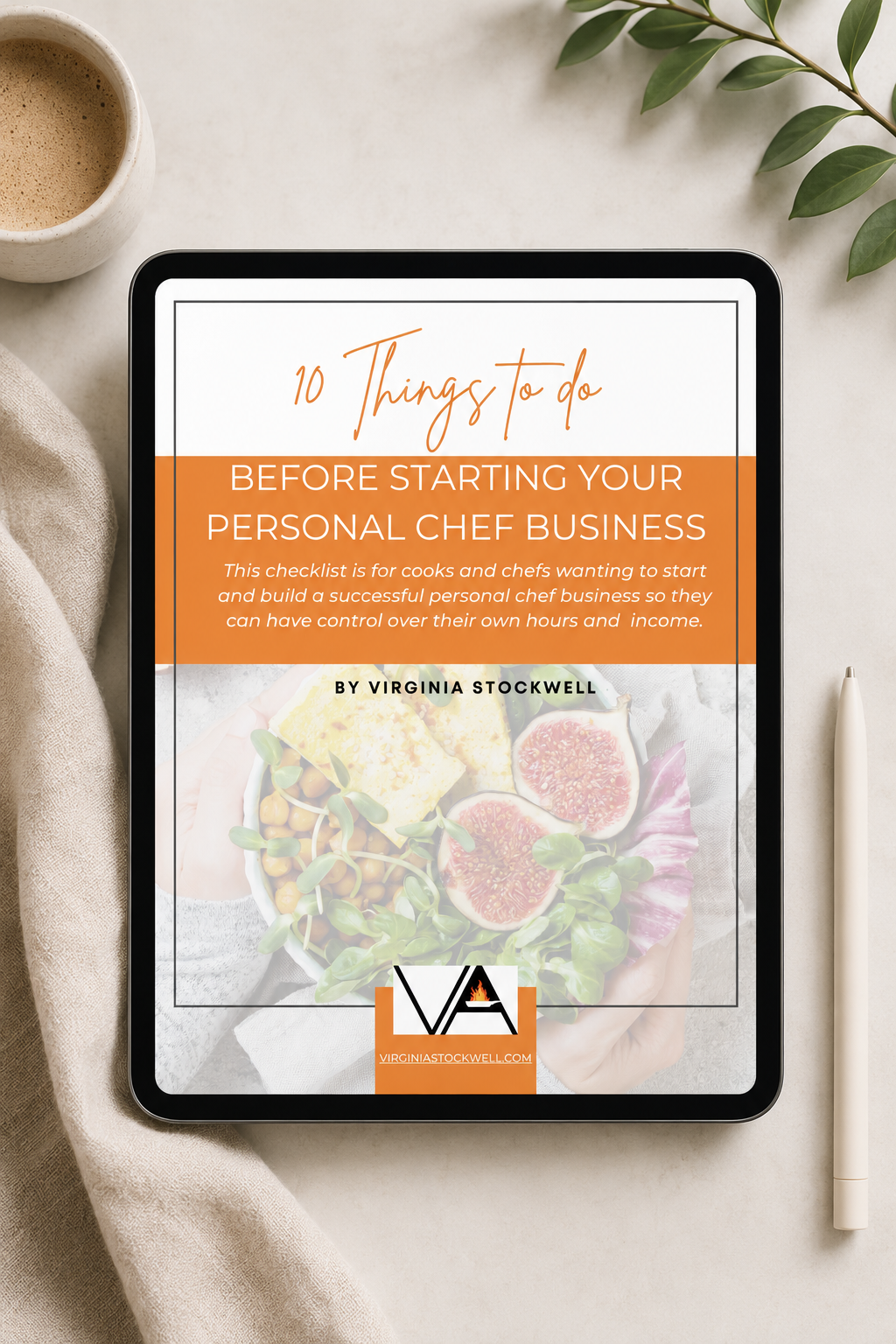
10-Step Actionable Checklist
FREE DOWNLOAD
10-Step Actionable Checklist
You've always said that "someday" you'll start that meal prep or dinner party business, but where do you begin?